Seed in Space
A Grade 9 pilot study on how space-like conditions change whether a seed germinates at all.
Investigated the effects of space-like conditions on seed germination through a pilot study, compiling how golden garden bush bean seeds reacted to a range of individually applied stressors. Inspired by the 2008 “Sakura in Space” incident, where 1,250-year-old cherry pits carried to the ISS sprouted on return to Earth with a six-times faster germination rate, the project set out to isolate which individual space component could be causing effects like that — and by how much.
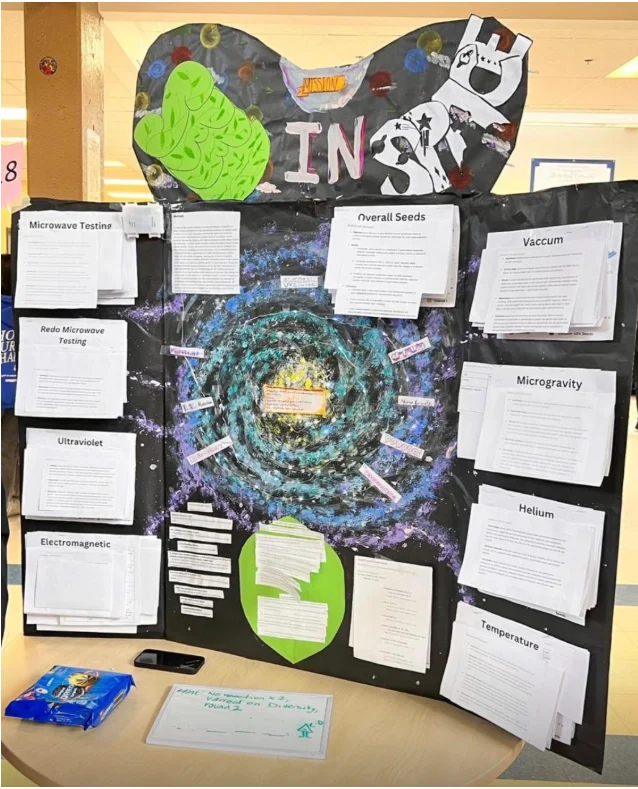
Conditions tested included microgravity, UV radiation, microwave radiation, near-vacuum, extreme temperature, a helium atmosphere, and magnetic field radiation — each isolated with its own control group and mini-lab report so its contribution to germination outcome could be read separately rather than as one combined “space” treatment.
Method
- Controlled greenhouse — every non-tested variable held constant at 21°C, 80% humidity and 8 hours of simulated sunlight a day, so each stressor could be read in isolation.
- DIY clinostat — built from a VexIQ robotics kit, borrowed from the school Robotics Club, spinning seeds at 15 rpm for 3 days to simulate microgravity.
- UV dosing — measured with a Sper Scientific 850009 UVA/B light meter, borrowed through BC Children’s & Women’s Hospital, across a range of exposures.
- Magnetic field testing — run in the school science lab under a teacher’s supervision, with seeds placed at both poles.
Findings
- Microwave & UV radiation — a moderate dose cracked the seed coat and sped up germination, but overdose broke the coat entirely, leaving the embryo vulnerable to excess water and negative mutations. UV peaked at a mid-range 17 uW/cm² exposure.
- Microgravity & near-vacuum — negligible change from the control, most likely because a plant’s starch-filled statoliths re-sense gravity as soon as spinning stops, and the vacuum chamber only reached 37–42%.
- Extreme temperature — heat helped (steam likely softened the coat), while cold hurt badly — consistent with bush beans’ known frost sensitivity rather than a space-specific effect.
- Helium atmosphere — unexpectedly accelerated germination, though the mechanism is still unclear.
- Magnetic field radiation — the biggest surprise: every seed placed at the south pole consistently sprouted two plants from one seed, pointing to a hormone-level mutation triggered during early seed production.
Recognition
- Regional Silver Medal — science fair.
- Lynn Valley Garden Club Special Award.